The UK is classed as a binge watching nation with 40 million of us watching episodes back to back. All of this is made possible by the ultimately convenient superpowers that are subscription streaming services like Netflix and Amazon Prime. But how does this change our TV viewing habits? And how do terrestrial television providers like the BBC compete? In this article, The Aerial Guys assess how the nation’s TV watching habits are changing and discuss how major players, like the BBC and Netflix, are vying for your viewing pleasure.
UK viewing habits
Ofcom figures from 2016 show that the average television viewer in the UK watched a total of 3 hours, 32 minutes of TV a day. People aged 16-24 watched an average of 1 hour 54 minutes of digital terrestrial TV a day, whereas, in stark contrast, viewers aged over 64 watched an average of 5 hours 44 minutes a day. Overall, 76% of people aged 16-24 were found to use a subscription TV service like Netflix or Amazon Prime, compared to 19% of people aged over 65. But, how do these statistics affect the viewing numbers for terrestrial TV providers like the BBC?

In this graph from Ofcom’s 2016 Communication Market report, we see the proportion of time spent watching, accredited to activities and by age group. Thinkbox CEO, Lindsey Clay has an interesting view on these statistics…
“These new figures show that TV dominates the video world for all age groups. Today’s young people watch on-demand forms of video more than the generations before that didn’t grow up with them. This makes sense as they do not tend to have control of the TV set and so turn to their personal screens to watch what they want. What is remarkable is that in the last decade, when so many new technologies and services have arrived that could have disrupted TV, TV viewing has remained so dominant.”
So, the question is – How is broadcast television viewing remaining so dominant when streaming or subscription video on demand (SVOD) superpowers, such as Netflix, are popular and cheaper in relative terms?
TV licence cost
With the annual cost of a TV licence sitting at £147 for UK citizens, it’s easy to see why audiences may be turned off by the classic digital terrestrial TV viewing experience and head online instead. Subscription viewing sites, such as Netflix, do not require a TV licence but still provide quality programming and cost significantly less, with the simplest package costing £71.88 per annum. However, the 2016 viewing habit statistics for the UK contradict this theory and actually reveal that UK audiences are remaining loyal to terrestrial TV… but why?
The BBC vs Netflix
The BBC has been a driving force across the UK since 1922 and sits atop its throne as a national treasure. It is the world’s oldest national broadcasting organisation and the largest broadcaster in the world by number of employees. It’s fair to say that it rests dearly in all of our hearts.
Firstly, we need to bear in mind that the BBC’s television game is strong, they produce fantastic quality programming that relates to a variety of people. They keep the UK public on their toes with eye-catching adverting, the use of highly regarded actors and generally gripping programming.
This Top Tens of 2016 report from BARB proves how dominant the BBC’s programming is across the board in the UK.
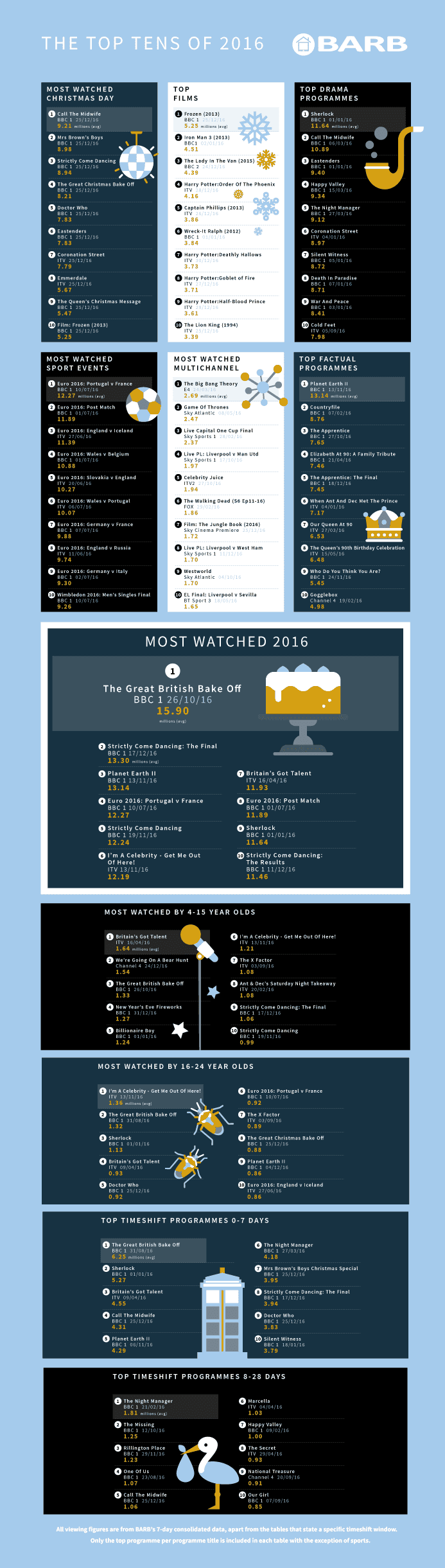
The BBC also provide an online catch-up service, BBC iPlayer, which also requires a TV licence to use. Arguably, the iPlayer provides a much more structured and intuitive user dashboard than Netflix, with the latter relying on algorithms to suggest recommendations tailored to the user. If you’ve ever tried to find a new episode or programme to binge watch on either platform, we’re sure you’d agree that there’s far less trawling time needed on the iPlayer. Plus, the quality of programming is generally always first-rate.
This quote taken from Ofcom’s 2016 Linear vs Non-linear Viewing report supports this theory…
“The vast majority of SVOD users valued the flexibility of being able to binge on whole series, rather than having to wait for the next episode to be broadcast. However, several participants thought that the sheer quantity of content available on SVOD services was not reflected in depth of quality. They expressed frustrations that certain programmes were not available on their SVOD service, or where incomplete numbers of seasons were offered for specific titles.”
Bearing all of this in mind, SVOD services in the UK are still extremely popular. The main reason for this is because of high budget, originally produced content, such as Netflix’s original series. In 2017, industry forecasts revealed that Netflix was due to spend $6 billion on original content, with Amazon not far behind with $4.5 billion worth of original programming, and the BBC struggling to compete with an overall TV programming budget of £1.6 billion (around $2 billion).
These Hollywood level production values are difficult to compete with, especially for a Public Service Broadcaster that is under intense scrutiny to account for every single penny of licence fee payer money. Pay TV platforms also offer far more opportunity to gorge on boxsets, bingeing back to back episodes of some of the most popular shows in recent years – such as Orange is the New Black, Top Gear and Stranger Things. This figure from Ofcom’s 2016 Communications Market report confirms the UK’s hunger for access to back catalogue programming.

UK viewers vote with their remote
Binge watching is a huge part of UK life and, for many viewers (25% to be exact!) the desire to obsessively keep up with programmes is driven by the fear of someone revealing an important ‘spoiler’. For some, the days of being tied to the TV schedule are fading, as more than a third of UK viewers are preferring to watch TV on their own terms.
However, 90% of people watch digital terrestrial broadcast TV every week, and family viewing is still an integral part of family life. Thirty per cent of adults say their family still watches the same programmes or films together every day, while 70% do so at least once a week. Nearly 68% say watching TV can bring the whole family together for a shared viewing experience.
The twenty first century is brimming with televisual convenience, and television viewing opportunities have blossomed in modernity’s wake. However, despite unlimited access to SVOD pay TV services in the UK, the public are still largely voting with their remotes and remaining loyal to digital terrestrial TV. Subscription TV is certainly making inroads, but The Aerial Guys predict that there is plenty of room for both types of TV viewing platforms to share equal billing for many years to come!