When you’re setting up Sky TV or dealing with reception problems, one of the first questions you might ask is — what satellite does Sky TV actually use? It’s more than a bit of trivia. Knowing the answer helps you understand how your system works, why your dish needs to face a certain way, and how to spot or fix problems when they crop up.
Whether you’re just getting Sky for the first time, switching from another service, or simply curious about how your favourite channels reach your living room, this guide will take you through exactly which satellite Sky uses, where it’s located, and why that matters for your viewing experience.
What Satellite Does Sky TV Use?
In the UK and Ireland, Sky TV broadcasts through the Astra satellite group, specifically Astra 2E, Astra 2F, and Astra 2G. These satellites are operated by SES, a major global satellite communications company, and are positioned in geostationary orbit at 28.2 degrees east.
Geostationary orbit means they appear fixed in the sky from the ground’s perspective. This is why, once your Sky dish is installed and aligned, it never needs to track the satellite as it moves — because it doesn’t appear to move at all. These particular satellites are designed with strong coverage over the UK, Ireland, and nearby regions, making them perfect for delivering Sky’s wide range of entertainment, sport, movie, and news channels.
Where is the Sky TV Satellite Located?
The Astra satellites Sky uses sit about 35,786 kilometres above the Earth’s equator, locked at 28.2° east. That figure is measured from a reference point on Earth and tells installers exactly where in the sky they need to point your dish.
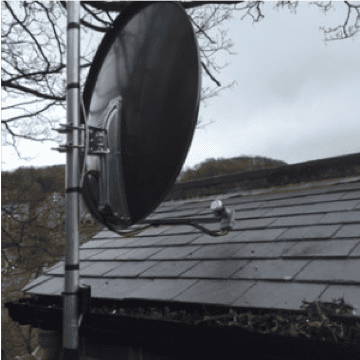
If you’ve ever noticed Sky dishes on different houses all pointing in roughly the same direction, that’s why. In Rotherham and most of the UK, your Sky dish will be aimed towards the south-east. The exact tilt and angle change slightly depending on your exact location, but the target remains the same — the Astra 2E, 2F, and 2G satellites.
Why Sky Uses the Astra Satellites
Sky’s reliance on the Astra 2 group isn’t by chance. These satellites offer a mix of features that match Sky’s needs perfectly:
- Wide Coverage – The signal footprint is optimised for the UK and Ireland, giving strong reception even in rural areas.
- High Capacity – Enough bandwidth to carry hundreds of channels, from standard definition to HD and UHD.
- Reliability – SES operates a robust network with backup measures to minimise downtime.
- Technology Compatibility – Designed to integrate seamlessly with Sky’s receivers, including Sky Q.
Because of these factors, Astra satellites have been Sky’s broadcasting home for many years.
Do All Sky TV Customers Use the Same Satellite?
Yes. In the UK and Republic of Ireland, all residential Sky customers use the Astra 2E, 2F, and 2G satellites at 28.2° east. The only variations are in what channels and services you can access based on your subscription.
This consistency means that whether you’re in Rotherham, Glasgow, or Cardiff, your dish will be pointing to the same location in the sky.
How to Align a Dish to the Sky Satellite
Pointing a dish at the Astra satellites is more precise than it might seem. Even a tiny misalignment can result in signal problems. Engineers focus on three key settings:
- Azimuth – The compass direction the dish faces.
- Elevation – The vertical tilt above the horizon.
- Skew – The rotation of the LNB (the receiver arm on the dish) to match the signal’s polarisation.
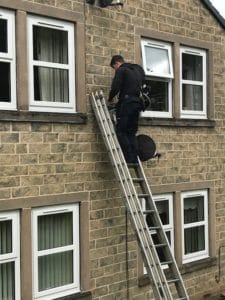
Professional installers use signal meters and alignment tools to get this perfect. While there are DIY guides and alignment apps, getting it wrong can leave you with weak reception or a picture that cuts out when the weather turns bad.
What Happens if Your Dish is Out of Alignment?
An out-of-alignment dish causes symptoms like:
- Pixelation and blocky images
- Sudden loss of sound
- Certain channels disappearing
- On-screen “no satellite signal” messages
- Problems that worsen during rain or strong winds
Misalignment can happen from wind, accidental knocks during building work, or bracket movement over time. The fix is normally straightforward for an experienced engineer, who can restore your channels as soon as the dish is realigned.
Does the Sky Satellite Work for Freesat and Other Services?
Yes, Freesat also uses the Astra satellites at 28.2° east. This means a Sky dish can often be connected directly to a Freesat receiver without needing re-alignment.
Some foreign language channels and free-to-air broadcasters also share the same position, though they may use different frequencies.
Can You Get Sky TV Without a Satellite Dish?
You can, thanks to Sky Glass. Instead of relying on a dish and satellite, Sky Glass streams TV channels over your broadband connection.
This can be a good option if you can’t have a dish fitted or prefer not to. However, it’s not for everyone:
- You need fast, stable internet.
- Some features differ from the satellite service.
- In some rural areas, satellite can still be more reliable.
For now, the traditional Astra satellite service is still Sky’s most robust and widely used option.
How Weather Can Affect Satellite Reception
While Astra satellites are designed for strong, stable signals, extreme weather can still cause issues. Heavy rain, snow build-up on the dish, or very strong winds can all impact the signal.
This is called “rain fade” and is a natural limitation of satellite broadcasting. A properly installed and aligned dish will resist most weather-related problems, but in extreme cases, the picture may drop briefly until conditions improve.
Future of Sky’s Satellite Service
With streaming growing in popularity, you might wonder how long Sky will keep its satellite service. The truth is, the Astra 2E, 2F, and 2G satellites are built for long operational lifespans, and millions of homes still depend on them.
In the coming years, we may see more of a hybrid approach, with satellite delivering live channels and broadband handling on-demand content. For now, the dish-and-satellite setup remains the most reliable way to get Sky.
Practical Tips for Maintaining Good Satellite Reception
- Keep trees trimmed if they’re near the dish’s line of sight.
- Avoid moving or tampering with the dish once aligned.
- Have an engineer check the installation if you notice consistent picture problems.
- Replace old or damaged cables for better signal quality.
These small steps can help you get the best from your Sky service.
Our Final Say!
Sky TV uses the Astra 2E, 2F, and 2G satellites at 28.2° east to deliver its channels across the UK and Ireland. This location stays constant for every customer, and it’s why your dish must be aligned with such accuracy.
Knowing which satellite your Sky system relies on helps you understand how it works, why alignment matters, and what to do if your picture starts to break up.
If you’re in Rotherham or nearby and need help installing or realigning your Sky dish, call us on 0800 092 0222. We can restore your picture quickly, often the same day, so you can get back to enjoying your favourite shows without interruptions.